Saturday, February 20, 2010

0

Lifestye and the repetition compulsion


Roses says in a comment on the last post


“Why then, is it that we need so badly to be locked in to a script?”


Our current leader of the opposition in Australia, Tony Abbott, got himself into hot water last week. He made the comment that for some homeless people it was a matter of lifestyle choice. That some chose that lifestyle to live.


The opposite argument to this is that it is not their choice but a result of poor economic conditions, neglectful government for the homeless and so forth. The psychologist would say that it is neither but it is something else altogether.


I worked in a prison for three years and without a doubt if an inmate wants to acquire work skills, improve their education level and so forth the opportunity is definitely there. There is a small group who do use their prison time to improve self but the majority do not tend to. Is that their choice? Most would say yes.


The good life


As one works with people over the years one finds that people will create lifestyles that are reflective of how they view themselves. If one has a good perception of self and respects self then over time they will create a lifestyle and relationships that reflect that belief of self. They create a good quality of life.


If one has been told they are useless, not wanted, beaten and neglected then they will tend to have a poor view of self. If this happens then as they go through life they will create relationships and lifestyles that reflect that poor view of self.


Hence those with a poor view of self will tend to end up destitute, in prison, a habitual drug user and so forth. However it is not always the down and outers. Having worked most of my life in private practice my clients have tended to be those who are financially stable. I have seen plenty of rich people who have horrible lives in terms of relationships, emotions and the predicaments they get themselves into. So its not just about homelessness and money.


Successful boxers a notorious for ending up with tragic lives

It is the long term out come that reflects ones level of self esteem


Just look at man of the moment - Tiger. His father drove him relentlessly and was swinging a golf club by age 2 and he has not been able to stop until just recently. He has plenty of money but what is the quality of his life? What it is in the long run will be a reflection of how he views himself. If he comes out of this and falls on his feet as they say then we know he has at least a reasonable opinion of himself. If he does not then he views himself in a much less favourable light and will create a crappy life for himself.


However the point at hand is that people will do this relentlessly. It is a very powerful driving force in them such that one could call it a compulsion and indeed Freud coined the term - repetition compulsion. People will tend to compulsively repeat the same over and over again and thus over time they end up with the same sort of lifestyle, relationships and so forth.


So it is a compulsion to adopt the same life script over and over. This means some of the homeless (like prisoners) will not take up the opportunities available to ‘improve’ their circumstances. This does happen and thus one can understand why some see it as a choice. The opportunities are there and they will not take them in the long run.


Is that a choice or a compulsion to create a lifestyle that reflects the current self image? If one decides it is a choice then the homeless are to blame. If one decides it is a compulsion to repeat the life script then it is not their fault and they are victims of unlucky circumstances.


Can it be a bit of both? Some do take up the opportunities and create a better life for self. Each and everyday I work with people who do precisely that. The goal is to improve ones view of self. If that happens then it is inevitable they will create better lifestyle for self. It will only be a matter of time until that is achieved.


Graffiti

Wednesday, February 17, 2010

0

Antiscript and the male mid life crisis


Eric Berne in his book “What do you say after you say hello” talks about the Antiscript. Here is a diagram of the antiscript. The child is born and from that point on it needs to make sense out of the world and who it is. In Transactional Analysis terms the child does that by making a whole series of early decisions based on how it is treated by its parents. As these are being made the child then comes to the conclusion about its life position or its basic understanding of its worth and the worth of others.


After these have been establish the child then is on the path of his life script. Some simply stay on that path and live their life following their script to its conclusion. Others when they reach adolescence veer away from the life script path onto the path of the what Eric Berend called the antiscript. At this point they stop following the life script, rebel against it and stop living by the injunctions and drivers given by the parents.


This will include the Rebellious Child ego state doing the opposite of the script programme as well as the Free Child trying out new non-script bound behaviours, feelings, attitudes and decisions.


The antiscript in adolescence usually lasts about 5 to 6 years and then we have the most important part of the antiscript process. When the teenager starts to get to the end of their antiscript period what do they do then? The main question is how much do they just swing back to the life script path and live that life out. This is where the counsellor can be of considerable use to the teenager. At that point where the antiscript period is ending.


Some people swing back one hundred percent to the life script path and spend the rest of their days living it out. Others swing back in varying degrees, that is they use the experience of their RC rebellions and their Free Child experimentations of the antiscript period to make non-script bound decisions on how they want to live their life. Using various therapy techniques the counsellor can help the teenager at this time in this way. From what I have seen most often the therapeutic opportunities afforded by the antiscript process are lost in counselling as the counsellor does not seize the moment to the advantage of the adolescent.


Some people spend much longer periods in the antiscript and will live a life style that is very contrary to what the parents programme was for them. For instance the man whose parents groomed him to be an accountant ends up living like a feral in the bush on a commune, living off the land. He does not swing back at all to the life script and stays stuck in the antiscript which can last for many years.


The other thing the counsellor needs to be advising, is for the teenager to avoid making major life decisions whilst in antiscript. For instance never choose a marital partner whilst in antiscript. My suggestion is that for Australian conditions never get married before the age of 25 years. The swing back from antiscript to script can be quite rapid and involve quite a marked change in personality, life goals and so forth. In a matter of 12 months a person can change quite dramatically on occasion. The person you married may all of a sudden go through major changes in their views, attitudes and goals of life.


This also applies in a choice of career which people in their late teens and early 20s are often considering. Letting the teenager know that they have time to choose and indeed may try a variety of occupational paths before ending up with the one they want. This can be a problem for some parents who want the child to get on a career path by age 19 when they go to university, take up a trade and so forth. The counsellor of the teenager can find it difficult going because of difficulties with the parents of the teenager rather than the teenager.


After the adolescent antiscript period ends once again people will continue on their life path with much less disruption to the person’s life script that occurred with the antiscript. Sometimes however there can be another period of antiscript disruption later in life. For some men this occurs with the mid life crisis.


The man has spent the past 20 years being responsible, working diligently, doing the right thing by supporting the family and so forth. At around 40 he realises this, looks at the next 30 years of his life and sees the same looming for him. For some this can be very disturbing such that they again move into an antiscript period. He leaves his wife, starts dating women half his age, buys a sports car, starts going to night clubs and hanging out with the ‘tragic’ singles set. He is doing the same as the teenager in that he realises what his life script is and thus makes a loud and unsophisticated attempt to alter it and veer onto a different life path.


From a therapy perspective the goals are the same as for the teenager. With the use of various therapy techniques the man is afforded the opportunity to use the experience of his RC rebellions and Free Child experimentations of the antiscript period to make non-script bound decisions on how he wants to live his life.


As with the teenager from what I have seen most often the therapeutic opportunities afforded by the mid life crisis antiscript period are lost in counselling as the counsellor does not seize the moment to the advantage of the middle aged man.


The key from a counselling point of view for any antiscript period is when the person is coming to the end of it one uses it to the therapeutic advantage of the client in the ways that I have described. Indeed there are many therapeutic interventions the therapist can use with the client when they are in the heights of the antiscript process that will also assist when the antiscript process in coming to its closure.


Graffiti

Friday, February 12, 2010

0

Skype counselling


As one does what one does and in my case that is psychotherapy and counselling one always seeks the new and different. Hey!! if you don’t one gets old in mind or in my case I would get bored out of my little mind. In recent times I have had occasion to do therapy using Skype on my computer.


Of course with a new medium of human communication comes new facetiae with that. The good and the bad I suppose one could say. If you have not used Skype, when you talk with someone you see their face in the main screen and also your own face in the bottom left hand corner.


On Skype you see two faces on the screen as you talk with the other person. The client’s in the main screen and yours in a smaller section at the bottom left hand corner. In a normal therapy setting it would be like having a mirror sitting next to the client that reflected back the top half of your body. One is constantly receiving two images - the client and yourself. This, as you can imagine is a new set of circumstances in the counselling situation. Not many therapists have a mirror set up next to the client so they can see their own reflection whilst counselling. With Skype you do whether you want it or not.


What does this new ingredient mean for the counselling process and the therapeutic relationship? Well I have been known to possess some of the traits of the narcissistic personality. Only the good ones and not the bad ones I may add! Thus Skype counselling means I can look at my self through the hour long counselling session. The perfect counselling session for the narcissistic personality. This is a good thing one may think. But if one does that clients will quickly tire of such self absorption on behalf of the therapist and c’est la vie, go find a real job.


Me, myself and I in Belgrade


But what it does mean if I get to see an image of myself continually in the treatment process? I get to see what the client sees on a second by second basis. This gives me one source of information and also I get to see my behavioural reactions to the client on a second by second basis which is the second source of information.


In non Skype therapy I have three main sources of information.

1. Behavioural observations of the client as they talk

2. The content of what they are saying

3. My Child ego state intuitive feeling reactions to the client


With Skype one has more sources of information.

4. What the client is seeing second by second

5. What my behavioural reactions to the client are on a second by second basis

6. My Child ego state intuitive feeling reactions to my behavioural reactions to the client.


As you can imagine this was a veritable tsunami of new information as a therapist. Never before have I been privy to such information from the client’s perspective. At the outset it was kind of information overload.


How can I take in all this new information, let alone comprehend it and compute it for the client’s benefit. Instead of the familiar three sources of information all of a sudden it had doubled to six sources of information. Slowly one develops a new method of information processing which is what I am doing at this stage of this new method of counselling.


This is probably incomplete, in fact I can say it is definitely incomplete and it will be edited later. Tomorrow probably. It is friday night at 10.58pm and I have had 2 glasses of chardonnay. I know i shouldn’t but what the heck


Graffiti

Thursday, February 11, 2010

0

The drug addict


I was asked a question in supervision yesterday about the drug addict and I gave an answer that I want to record and thus it is going in as a blog post to join my tome.


As I have mentioned before there are different types of drug users. One that gets a lot of notice is the drug addict type of user. This is the person who finds it really, really, really hard to stop using. Or more correctly they do not find it that hard to get off drugs but they find it really hard to stay off drugs. In their histories they have often given up on many occasions but they always start using again.


This type of drug user represents only a small number of the overall drug using population. By far the largest group is the recreational drug user who uses drugs intermittently in their life and it never causes them any real problems. Whereas the drug addict type of user ends up with numerous familial, legal. financial and health problems as a result of the drug use. Whilst they are a small group in number they are the ones who use up most of the resources - health, police, courts and so forth.


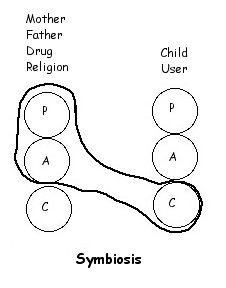
When you listen to these people talk about their relationship with the drug one finds an uncanny resemblance to the same qualities one finds in a relationship between a child and a parent. Of course a child is dependent on a parent and one finds the drug addict type of user with a similar type of dependence on the drug. So we end up with a symbiosis as such:


A young child is dependent on it’s mother and as it grows it is meant to become more psychologically separate from mother. As this happens then the dependency reduces and the original symbiosis is broken. If it does not happen then the dependency does not reduce and one develops what is called the dependent personality. This type of person can then become a drug dependent individual - the drug addict. See White for more on this. The recreational drug user does not have this personality trait and thus they do not become drug dependent in the same way.


So what is the solution? Can these people stop using drugs and if so how? My answer to that is yes they can, as some do, and there are a number of ways depending on their circumstances.


1. Switch the dependence. These people are psychologically dependent people as was described above. They can stop using by switching the dependence. Thus they still remain dependent but on something besides the drug. One sees this happen sometimes with religion. If the drug addict seeks a religious based treatment for their addiction some times they can become addicted to the religion and thus stay off the drugs.


An OK solution to my mind. For some AA can be the same. The addiction can be anything though from religion, to sport, to sex, to a person or whatever. It would seem to be much better to be addicted to religion than to heroin.


2. Grow out of it. One does not find many 40 year old heroin addicts. If they survive their twenties and thirties as most do they get tired of the highly charged lifestyle, mature a bit with age and start needing the drug less. If you are working with a 25 year old habitual heroin user the goal may be to help them get through the next decade and then they are more likely to start to tire of the lifestyle and then one has a real chance of them ceasing to use for long periods of time.


3. The psychological solution or cure. Whilst this solution is possible it does take a significant amount of time and money, thus one needs to be realistic and see that it may work for a minority but the majority are going to need to look for the other solutions.


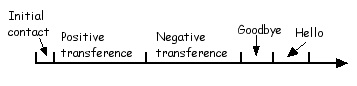
The solution is via a transference cure where the process is as such:


In essence the client develops an attachment to the therapist and thus a symbiosis develops like shown above. The addict becomes dependent on the therapist in the same way. This growth of dependency happens in the positive transference stage. After a time that ceases and the client goes into a negative transference where they fight the therapist in many and varied ways. The separation stage begins.


This is the crucial part of the cure as this is what the person never completed in childhood. In the negative transference the client begins to psychologically separate from the therapist, thus they breakdown the symbiosis so their dependency on the therapist reduces until they basically outgrow them and don’t need them anymore. The dependent quality in their personality reduces and thus they become less dependent on the drug.


Graffiti

Friday, February 5, 2010

0

The timing of grief

The grief graph shows the usual timing of grief reactions. This relates to sudden loss only, where the death or removal of the person is unexpected and permanent. Where the loss is anticipated such as with a long terminal illness the grief graph is quite different for the bereaved.


When the loss occurs there is the initial reaction of shock. This would rarely be longer than a few days. This is where the Child ego state incapacitates and basically goes into a state of complete non functioning cognitively, emotionally and behaviourally. The person in essence curls up in the foetal position and stays there. The person deals with a piece of very repugnant information (such as the death of a loved one) by collapsing in on self. The information is not being denied instead the information is not even being comprehended in the first place. If this lasted into weeks then one would essentially be in some form of catatonic state.


When this passes the person will be in a state of denial. The information is now comprehended by the person but the Adult and Child ego states deny that it is true. By whatever means, and by some kind of magical thinking the person convinces self that what they are being told is not true.


This also usually passes quite quickly at one level. The Adult ego state usually has to reasonably quickly accept the facts that the person is now no longer there. When this happens on the grief graph one can see the feelings of sadness and grief rapidly rise to quite a high and intense level. At this point the person’s everyday life each and every day is significantly effected by the strong distressing emotions to the extent that the ability to work, relate and recreate can be significantly effected.


This is indicated by Roses comment on the post on Depression and suicide:


“I realise now. Grief isn't about feeling sad or happy or anything like that. Its not like that at all. It, some how, is a physical thing. I can't just shake it off like everything else. It's not like a cloak i have to wear for a time so when i need a break from it, i can just take it off for a little bit and then put it back on when i need to. No. It's inside and it's all the time. Its something we carry on the inside that can't be let go of or put down for a bit. It just is.”


This shows the ever present nature and strong presence of the grief in the very early days after the loss.


Even though the Adult can not stay in denial for too long the Child ego state can remain in denial for very long periods of time, indeed years at a time. The Child magically sort of somehow believes that the person is not really gone or really dead. The individual sort of talks about the person like they are still alive. The person refuses to remove the deceased’s clothing from the cupboards or when walking along the street they catch sight of a person in the corner of their eye and they quickly think they have seen the deceased.


Indeed the very function of the period of grief and sadness in the grief graph is to break down the attachment and for the Child ego state to come to realization that the person is really dead. To end the denial.


It has been widely noted that the symptoms of depression are also commonly found in normal grief reactions. The two are quite psychologically similar. This is why depression often involves some kind of unresolved grief. Thus in the treatment of many, if not most depressed individuals one needs to find the time(s) when they did not grieve properly in childhood and redo the grief and goodbye work about the losses experienced. Depression often is an unsophisticated attempt by the Child ego state to resolve past grief reactions that it never successfully concluded. Depression is a recreation by the Child of process described by the grief graph.


If the grieving proceeds normally in a Free Child manner then over time the intensity and frequency of sadness and grief slowly decrease. After 6 months there will be a significant drop in the intensity and frequency such that there will be a noticeable difference experienced by the bereaved. By 18 months the vast majority of the painful grief is gone and life continues onward. Full psychological readjustment after the death of a very closed loved one probably occurs about 4 years after the death.


Those who report significant grief beyond these times are getting some form of significant secondary gains from the grief and loss process. Thus the process is dragged out much longer, even for a lifetime in some instances.


Graffiti

Thursday, February 4, 2010

0

Human communication


Skype is really cool!!

If anyone is wanting to be on my contact list just email me at


agbw@bigpond.com


Graffiti

Sunday, January 31, 2010

0

Depression and suicide


7. Depression as an indicator of suicidal thoughts and actions. One sees a great deal written about suicide and depression in the literature and unfortunately it is quite a misunderstood area. All sorts of statistics quoted. For instance George (2008) states, "A retrospective study of 132 young people who completed suicide in Western Australia found that nearly three quarters had shown definite signs of depression in the weeks prior to their death"(p.25) Or, "Depression increases the risk of suicide by 15 to 20 times, and about 4% of people with depression die by suicide."(p1373), Hawton, and van Heeringen, (2009). This of course means that based on this research ninety six percent of people with depression do not die by suicide. Other research has varying figures. Clark and Fawcett (1992) estimate that fifteen percent of those with a diagnosis of major depression will complete a suicide. The statistics tend to waver around the ten percent mark which means that the vast majority of those with depression will not complete a suicide attempt. There are many depressed people who are not suicidal at all. Of course this does not mean that one forgets about making an assessment of suicide with the person reporting depression but one needs to be realistic about its occurrence which is not often found stated in the literature.

Key symptoms of depression related to a risk assessment

In real terms depression is merely a collection of symptoms, it is not so much that depression is linked to suicide it just happens that people who are suicidal have symptoms which are not uncommon in depressed people as well. In using this measure in a suicide risk assessment one does not enquire about depression per se but one enquires about some of the symptoms found in the depression that the person is displaying.


The DSM-IV provides a list of symptoms which define depression, these being:

1. Depressed mood most of the day which can include a sense of hopelessness.

2. Loss of interest or pleasure (in all or most activities, most of the day).

3. Large increases or decreases in appetite (significant weight loss or gain).

4. Insomnia or excessive sleeping (hypersomnia).

5. Restlessness as evident by hand wringing and similar other activities (psychomotor

agitation) or slowness of movement (psychomotor retardation).

6. Fatigue or loss of energy.

7. Feelings of worthlessness, or excessive or inappropriate guilt.

8. Diminished ability to concentrate or indecisiveness.

9. Recurrent thoughts of death or suicide.

Taken from, American Psychiatric Association (1994).


In this diagnostic system one needs to have five or more of these symptoms to be diagnosed as depressed. Thus every suicidal person automatically has one symptom of depression already as shown in symptom number nine. The best clinical predictors of suicide in depressed people include previous self-harm, hopelessness and suicidal tendencies. (Beck, Steer, Kovacs and Garrison (1985) and Beck, Brown and Steer (1989) both found hopelessness to be one of the best indicators of suicide risk). If the depressed person reports a loss of appetite, psychomotor agitation, excessive guilt, hypersomnia and increased indecisiveness then they meet the criteria of depression but show none of the best clinical indicators just described. Indeed unless the depressed individual reports the last symptom, recurrent thoughts of death and suicide, it seems safe to say that the person is not a suicide risk at this time. They are not even thinking about suicide at this point even if they have all eight other symptoms of depression. If a person presents as depressed one firstly asks if they have the symptom of thoughts of suicide and if they do then one also enquires about a sense of hopelessness and any previous self harm. If they present with all three one is getting a much more accurate assessment of the current level of risk.


In the literature one finds very little research on the number of people who report depression and who report no recurrent suicidal thoughts. One has to search long and hard and three such research studies were found. The first from many years ago by the 'father' of depression, Arraon Beck (1967). He presented research results which examined the presence of suicidal wishes in the depressed person. He makes the distinction between neurotic depression or the milder forms of depression and psychotic depression or the more severe forms of depression. (This distinction will be discussed more later in this chapter). The results were:

Mild or moderate level of suicidal wishes present:

Neurotic depression - 58%

Psychotic depression - 76%

Severe level of suicidal wishes present:

Neurotic depression - 14%

Psychotic depression - 40%


More contemporary research by Akechi, Okamura, Kugaya, Nakano, et al (2000) reports that in patients with major depression fifty three percent had suicidal ideation. Wada, Murao, Hikasa, Ota, et al. (1998) also report a similar finding of around fifty percent of those with major depression having suicidal urges as well. This allows the conclusion that about fifty percent of those with some form of depression do not report any recurrent suicidal thoughts. Thus it seems safe to say that fifty percent of depressed people are not at risk of suicide as they are not even thinking about suicide let alone planning anything.


Timing of the depressive episodes

If the individual does present as depressed and does show the principle signs of recurrent suicidal thoughts, a sense of hopelessness and previous self harm then of course this is an important factor in the risk assessment and definitely requires more investigation. One of the more important aspects to investigate is the course and stage of the depression. As stated by the Bayley (2004) depressive episodes can be single, recurrent or chronic and this has significant implications for the assessment and management of the suicidal individual.


For about five to ten percent of depression sufferers the depression is chronic. If an individual with chronic depression also has recurrent thoughts of suicide then the level of risk increases and over time it could be seen as continuing to increase. In the longer term this person could be seen as quite a significant suicide risk. One would to be questioning the individual as to their feelings about tiring of life and particularly a sense of hopelessness. These individuals have a poor quality of life with the spirit crushing depression and often quite unpleasant side effects from the medication like obesity, lack of energy and so forth. If they have tried just about every type of medical and psychological treatment with little improvement one would be assessing a definite increase in the risk of suicide.


To make matters worse there is not much one can do in their management. A no suicide contract is of less use as there is no end in sight for the depression. As the suicide risk increases over time one can place them in hospital or on some kind of suicide watch but what does that achieve? It simply relocates them geographically and how long does one keep such a person in hospital as they will be depressed upon release.


However for most depression is cyclical as is shown in diagram 4 with the mood changing over time from a normal level to a depressed level and back.
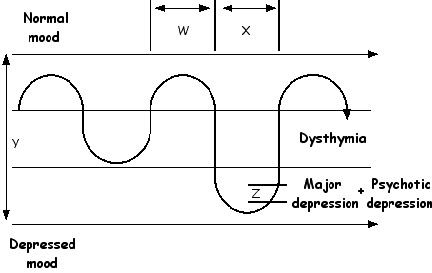

Diagram 4

The cycles of depression


As stated in the Bayley (2004) the rate of recurrence of depressive episodes is quite high, "50% of people who have had one episode of depression will relapse, 70% of people who have had 2 episodes will relapse, and 90% of people who have had 3 episodes will relapse"(p159). The average duration of an untreated episode is about twenty to twenty six weeks but many can have much briefer episodes of around four to six weeks. If treatment is obtained early then the duration and severity of the episode may be significantly reduced.


Types of depression

In using depression as a measure to assess suicide risk one needs to distinguish a number of different types of depression. As is shown in diagram 4 one can move from a normal mood range into the range of dsythymia. In this phase the depressive symptoms are at a moderate degree. Historically this has also been known as neurotic depression and I use the terms interchangeably. This is seen as less severe than the next level which is called a major depression. In this phase the depression symptoms are at a severe degree. Sometimes this is called 'clinical depression' and the individual is significantly incapacitated and is very depressed. Also at this level one can have a condition known as psychotic depression. This is where the individual has the symptoms of major depression plus some psychotic symptoms. This terminology has been around for many years and psychotic depression is well summarized by Beck (1967) who says it is "...characterized as including patients who are severely depressed and who give evidence of gross misinterpretation of reality, including at times delusions and hallucinations"(p82).


In summary in this model we have:

Normal mood

Dysthymia or neurotic depression

Major depression and psychotic depression


In diagram 4 we have an individual who begins with a period of normal mood who then moves into a phase of depression that is consistent with the diagnosis of dysthymia. Eventually that depressive episode ends and he recovers again for a period of normal mood. Unfortunately at a later time he again moves into a more severe episode of a major depression which he eventually recovers from and moves back to a state of normal mood. To assist with making a suicide risk assessment one can create a graph like this for the person who complains of depressive episodes.


In assessing the depressed person one need to look at four aspects of the depressive cycle W, X, Y and Z. Firstly one is wanting to assess the length of the non depressed periods (W) and the lengths of the depressive episodes (X). Of course this relies on the person having had previous episodes and one simply takes a history of the person in this way. How many have there been and how long were they? Also were there any precipitating factors such as marital problems or financial difficulties that lead to the depressive episode. These can then be charted on a graph as is shown in diagram 4. People tend to behave in patterns and one is obtaining this information to assist in predicting future episodes and thus future times when suicidal urges may increase in conjunction with the depression. Of course future episodes may be different to past ones but this does give some guidance to assist the suicide risk assessor.


For example if there is a pattern in the timing of the episodes one then knows when approach the person for a risk assessment in the future. A good example of this is with what has become know as Seasonal Affective Disorder or SAD. Typically the depressive episode begins in autumn or winter and remits in spring. Alternatively previous depressive episodes may be related to particular events such as examination time at college or when a loved one has to travel away for work. Plotting the 'W' and 'X' of the depressive episodes will allow the risk assessor to improve the timing of their assessments.


Degree of depression and suicidality

One also needs to assess the quality of the depressive episodes by making an assessment of the 'Y' component. Here one assesses how depressed the person becomes, how the person has felt in past episodes particularly in relation to suicidal thoughts. As mentioned before the system being presented here distinguishes between normal mood, dysthymia or neurotic depression, major depression and psychotic depression.


This is an important component to distinguish in a suicide risk assessment as there is some research which concludes that those who are more depressed are more prone to suicidal thoughts. In their research on depression and suicidal thoughts Garlow, Rosenberg, Moore, Haas, et al (2007) report “These results suggest that there is a strong relationship between severity of depressive symptoms and suicidal ideation in college students...”(paragrpah 1). In addition Perroud, Uher, Marusic, Rietschel, et al (2009) state “Increases in suicidal ideation were associated with depression severity...”(p2). Finally Beck (1967) cites research which shows that a severe level of suicidal thoughts were present in fourteen percent of those with neurotic depression and in forty percent of those with psychotic depression. In conclusion, the more depressed one is the higher the risk level of suicidal thoughts. Thus one can see the importance of making the 'Y' component assessment of the reported depressive episodes.


As just noted the person with major depression or psychotic depression is at more risk of suicidal thoughts than the person with dsythymia. However it seems reasonable to conclude that the person with psychotic depression is still at even more risk than the person with major depression as a psychotic depression involves a major depression plus the presence of psychotic symptoms. That is the person experiences severe depression as well as psychotic delusions and hallucinations and thus the features discussed above in point 4, "History of mental illness" become apparent as well. There is sort of doubling effect of suicide risk factors in this instance. For example the person with psychotic depression is likely to be more regressed than someone with major depression because the psychotic features result from very poor Adult ego state functioning and thus there is increased regression. In addition the psychotic is more prone to command hallucinations as well. As a result, of all the types of depression the psychotic depression is probably the one of highest risk value when making a suicide risk assessment.


Finally in diagram 4 one needs to make an assessment of 'Z' in the depressive cycle. Suicide risk may increase as the person improves particularly in a major depression or a psychotic depression. In these depressive states the person is so depressed that they become incapacitated. They are so depressed that they literally do not have the energy to think seriously of suicide or certainly making any definite planning moves. As the depressed state lifts, along with that comes an increase in energy which may bring about an increased ability to act on any self destructive wishes, as they improve one may need to be more vigilant as they reach that part of the depressive cycle.


In addition for the individual with psychotic depression as the depression lifts the psychotic symptoms may begin to subside as well. Their Adult ego state becomes more functional and thus planing a suicide attempt becomes more of a possibility. Most suicides occur in the non-florrid stages of a psychotic episode when the person is relatively free from acute symptoms. Of particular note in suicide risk assessment if the person is at one of the lower points in the depressive cycle such as at stage 'Z' and all of a sudden shows significant improvement, that may be ominous sign. They may have made the decision to kill self and are just getting organized and waiting for the right time.


Graffiti